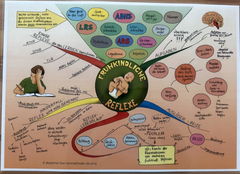
A very important topic, I think. If you treat your employees and your fellow human beings with appreciation, everything becomes easier. Maybe first you create your own KAWA, write the word in the middle and think about what ideas you have about it yourself. Only then do you look at our KAWA and get further inspiration. In the best case, you start thinking, and in the very best case, you start acting.
KAWA, according to Vera F. Birkenbihl, is an acronym and stands for: Kreative Ausbeute von Wort-Assoziationen (Creative Exploitation of Word Associations). But KAWA is easier to remember. You can create KAWAs on any topic that interests you.
First, you write the topic in large letters in the middle. By the way, I always use the paper horizontally and draw the letters so that they can be colored later. In our Mind Map Template Ring Block, KAWAs are drawn on the left white page. Now you let your thoughts wander and consider what comes to mind about the term and what would be important enough to write down. The rule of the game is: what is written down must begin with one of the letters in the middle. The smaller the term, the fewer letters you have available, and the more you have to think. The lack of letters forces you to think about a topic more intensely. By the way, it is not mandatory to fill every letter. And: there is no right or wrong with KAWA. An example: suppose you want to create a KAWA about your best friend Eva, then you only have three letters available. But you can use them multiple times. Perhaps E stands for elegant, successful, eloquent, for V you find her trustworthy, crazy, and in love, and for A you have associated silly and single. If your best friend had been named Hannelore, you would, of course, have had more letters available.
If you also clothe the whole thing in many pictures, your KAWA becomes a KAGA, and the G then stands for graphic design. I myself often write in KAWA form during meetings. This keeps me alert, no matter how unimportant or boring a meeting is. And I catch everything. Here is an example on the topic: Have fun, Jens Voigt