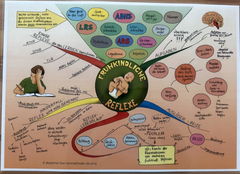
What are the effects of such learning difficulties? What learning difficulties even exist and what help can one seek? Now also available as a package with a black and white template + an empty template is included for free.
KAWA according to Birkenbihl is an acronym and means: Kreative Ausbeute von Wort-Assoziationen (Creative Exploitation of Word Associations). But KAWA is easier to remember. Hence the name. KAWAs can be made on all topics that interest you.
Write the topic in large letters in the center of the page.
👉 Tip: Landscape format is best. In our mind map template notepad, you'll find just the right spot for it on the left white page.
Let your thoughts wander and consider which terms come to mind about the topic.
The special challenge:
Each term must begin with one of the letters from your topic.
The shorter the word, the fewer letters you have available – and the more you have to strain your brain.
Your goal: To find at least one suitable term for each letter.
Repeat letters if multiple ideas come to mind.
Topic: Eva
E as in elegant, successful, eloquent
V as in trustworthy, crazy, in love
A as in silly, single
If your friend had been named Hannelore, you would have had significantly more letters available – and correspondingly more food for thought.
The limited letter selection forces you to think more intensely than with a simple ABC list.
You train your brain in creativity, associations, and memory retention.
KAWA keeps you active even in boring situations – e.g., during a meeting or lecture.
Ultimately, a clear, visual structure emerges that is easy to remember.